
From founder-led momentum to system-supported growth
Overview
IVY, a nearly 100% organic-traffic-only brand, is a premium women’s fashion reseller and retailer built through a decade of taste, trust, and long-standing customer relationships. Operating with nearly zero paid acquisition, the business grew organically beyond seven figures annually through in-store loyalty, online sales, word-of-mouth, and the founders’ direct involvement across buying, merchandising, customer communication, social media, and daily operations.
In the early years, this model worked well as managing every decision was a reasonable demand for founders, but as the brand grew, the business' operations became more complex and competition became more fierce as other resellers and retailers began selling many of the same brands as IVY. Over time, the competitive moat became thinner, the need for sales tactics grew exponentially and the rate of activities requiring hands-on involvement from the founders continued to rise.
By early 2024, that model began to fracture. The business’ performance had slowly started to decline at a compounding rate. A significant decrease in founder capacity from changing life stages and external circumstances introduced a hard constraint on how much manual effort could continue to carry the business. Without change, the business would not simply slow; it would become operationally brittle.
Stability became the first priority — not growth for growth’s sake, but protecting revenue while reducing the need for the same amount of effort required from the founders.
But stabilizing the business alone would not solve the underlying issue.
Sectors
Fashion
Beauty
Lifestyle
From founder-led momentum to system-supported growth
Overview
IVY, a nearly 100% organic-traffic-only brand, is a premium women’s fashion reseller and retailer built through a decade of taste, trust, and long-standing customer relationships. Operating with nearly zero paid acquisition, the business grew organically beyond seven figures annually through in-store loyalty, online sales, word-of-mouth, and the founders’ direct involvement across buying, merchandising, customer communication, social media, and daily operations.
In the early years, this model worked well as managing every decision was a reasonable demand for founders, but as the brand grew, the business' operations became more complex and competition became more fierce as other resellers and retailers began selling many of the same brands as IVY. Over time, the competitive moat became thinner, the need for sales tactics grew exponentially and the rate of activities requiring hands-on involvement from the founders continued to rise.
By early 2024, that model began to fracture. The business’ performance had slowly started to decline at a compounding rate. A significant decrease in founder capacity from changing life stages and external circumstances introduced a hard constraint on how much manual effort could continue to carry the business. Without change, the business would not simply slow; it would become operationally brittle.
Stability became the first priority — not growth for growth’s sake, but protecting revenue while reducing the need for the same amount of effort required from the founders.
But stabilizing the business alone would not solve the underlying issue.
Sectors
Fashion
Beauty
Lifestyle
When years of growth hide a relevance gap
Multiple years of high double-digit to three-digit percentage annual sales growth had concealed a strategic vulnerability and placed them in a fragile competitive trap many businesses face as market competition grows: sales for the sake of top-line growth.
Once a full competitive landscape report was produced, clear, but uncomfortable truths surfaced:
With no clear differentiator and selling similar products as their competitors, they were being forced to stay relevant to customers with one operating rule: price every product 10% lower than the lowest-priced competitor.
Competing in price wars also meant training their customers to expect — and wait for — discounts while lowering the brand’s perceived value. Conversion efficiency had significantly deteriorated with a lower percentage of online shoppers becoming customers each year, more traffic was needed to reach the same revenue levels. Despite periods where traffic quadrupled relative to baseline, revenue growth increasingly required disproportionate traffic.
As a result of the changing social media landscape and being an organic-acquisition only business, discounting to stay relevant was no longer a viable option.
Most brands reselling clothing end their years with single to bottom-of-scale double-digit net margins and commodity-level brand perception, but IVY’s customer interviews revealed significant opportunities for the brand to be different:
Their highest-value cohort – customers who had each spent up to multiple five figures with the brand over the past few years – consistently purchased for uniqueness, fit, and the sense of self each piece evoked within them rather than price. The following cohort showed similar patterns, indicating latent demand for exclusivity the existing strategy was not serving.
Overview
Sectors
Fashion
Beauty
Lifestyle
From founder-led momentum to system-supported growth
IVY, a nearly 100% organic-traffic-only brand, is a premium women’s fashion reseller and retailer built through a decade of taste, trust, and long-standing customer relationships. Operating with nearly zero paid acquisition, the business grew organically beyond seven figures annually through in-store loyalty, online sales, word-of-mouth, and the founders’ direct involvement across buying, merchandising, customer communication, social media, and daily operations.
In the early years, this model worked well as managing every decision was a reasonable demand for founders, but as the brand grew, the business' operations became more complex and competition became more fierce as other resellers and retailers began selling many of the same brands as IVY. Over time, the competitive moat became thinner, the need for sales tactics grew exponentially and the rate of activities requiring hands-on involvement from the founders continued to rise.
By early 2024, that model began to fracture. The business’ performance had slowly started to decline at a compounding rate. A significant decrease in founder capacity from changing life stages and external circumstances introduced a hard constraint on how much manual effort could continue to carry the business. Without change, the business would not simply slow; it would become operationally brittle.
Stability became the first priority — not growth for growth’s sake, but protecting revenue while reducing the need for the same amount of effort required from the founders.
But stabilizing the business alone would not solve the underlying issue.
From founder-led momentum to system-supported growth
Sectors
Fashion
Beauty
Lifestyle
Overview
IVY, a nearly 100% organic-traffic-only brand, is a premium women’s fashion reseller and retailer built through a decade of taste, trust, and long-standing customer relationships. Operating with nearly zero paid acquisition, the business grew organically beyond seven figures annually through in-store loyalty, online sales, word-of-mouth, and the founders’ direct involvement across buying, merchandising, customer communication, social media, and daily operations.
In the early years, this model worked well as managing every decision was a reasonable demand for founders, but as the brand grew, the business' operations became more complex and competition became more fierce as other resellers and retailers began selling many of the same brands as IVY. Over time, the competitive moat became thinner, the need for sales tactics grew exponentially and the rate of activities requiring hands-on involvement from the founders continued to rise.
By early 2024, that model began to fracture. The business’ performance had slowly started to decline at a compounding rate. A significant decrease in founder capacity from changing life stages and external circumstances introduced a hard constraint on how much manual effort could continue to carry the business. Without change, the business would not simply slow; it would become operationally brittle.
Stability became the first priority — not growth for growth’s sake, but protecting revenue while reducing the need for the same amount of effort required from the founders.
But stabilizing the business alone would not solve the underlying issue.
Overview
From founder-led momentum to system-supported growth
IVY, a nearly 100% organic-traffic-only brand, is a premium women’s fashion reseller and retailer built through a decade of taste, trust, and long-standing customer relationships. Operating with nearly zero paid acquisition, the business grew organically beyond seven figures annually through in-store loyalty, online sales, word-of-mouth, and the founders’ direct involvement across buying, merchandising, customer communication, social media, and daily operations.
In the early years, this model worked well as managing every decision was a reasonable demand for founders, but as the brand grew, the business' operations became more complex and competition became more fierce as other resellers and retailers began selling many of the same brands as IVY. Over time, the competitive moat became thinner, the need for sales tactics grew exponentially and the rate of activities requiring hands-on involvement from the founders continued to rise.
By early 2024, that model began to fracture. The business’ performance had slowly started to decline at a compounding rate. A significant decrease in founder capacity from changing life stages and external circumstances introduced a hard constraint on how much manual effort could continue to carry the business. Without change, the business would not simply slow; it would become operationally brittle.
Stability became the first priority — not growth for growth’s sake, but protecting revenue while reducing the need for the same amount of effort required from the founders.
But stabilizing the business alone would not solve the underlying issue.
Sectors
Fashion
Beauty
Lifestyle
Overview
From founder-led momentum to system-supported growth
IVY, a nearly 100% organic-traffic-only brand, is a premium women’s fashion reseller and retailer built through a decade of taste, trust, and long-standing customer relationships. Operating with nearly zero paid acquisition, the business grew organically beyond seven figures annually through in-store loyalty, online sales, word-of-mouth, and the founders’ direct involvement across buying, merchandising, customer communication, social media, and daily operations.
In the early years, this model worked well as managing every decision was a reasonable demand for founders, but as the brand grew, the business' operations became more complex and competition became more fierce as other resellers and retailers began selling many of the same brands as IVY. Over time, the competitive moat became thinner, the need for sales tactics grew exponentially and the rate of activities requiring hands-on involvement from the founders continued to rise.
By early 2024, that model began to fracture. The business’ performance had slowly started to decline at a compounding rate. A significant decrease in founder capacity from changing life stages and external circumstances introduced a hard constraint on how much manual effort could continue to carry the business. Without change, the business would not simply slow; it would become operationally brittle.
Stability became the first priority — not growth for growth’s sake, but protecting revenue while reducing the need for the same amount of effort required from the founders.
But stabilizing the business alone would not solve the underlying issue.
Sectors
Fashion
Beauty
Lifestyle



From discount wars to a brand customers see themselves in
The first intervention was not operational. It was creating a clear definition of who they were, what they stood for, and which brand world their customers belonged to. They needed their customers to see themselves in the brand.
IVY’s story was transformed into something customers could emotionally connect with:
A mother-and-daughter-run boutique curating premium global styles not yet available in Canada for women who had aged out of trend-driven fast fashion but did not want to lose their sense of individuality.
That positioning shift created more exclusivity and anticipation for releases.
That became an operating filter. It governed buying decisions, pricing tolerance, visual language, and marketing restraint.
More customers were pulled toward buying what made them feel comfortable and confident in their clothes while remaining distinctive from their peers and were more willing to invest in premium products they knew would last.
The new positioning allowed IVY to reduce reliance on price competition while strengthening pricing power on select lines, without increasing acquisition pressure.


Turning positioning into systems
Immediately following the first phase of changes, the online store began converting nearly 1.5x the amount of traffic the following two months with three quarters to nearly half the amount of traffic compared to the previous year. The following six months – a typically slow period for seasonal businesses like IVY’s – they turned an average of over 2.25x more visitors into customers without paid acquisition.
At this stage, continued growth without structural reinforcement would have increased dependency and operational pressure.
With a clear value proposition in place, the work moved from story to frameworks.
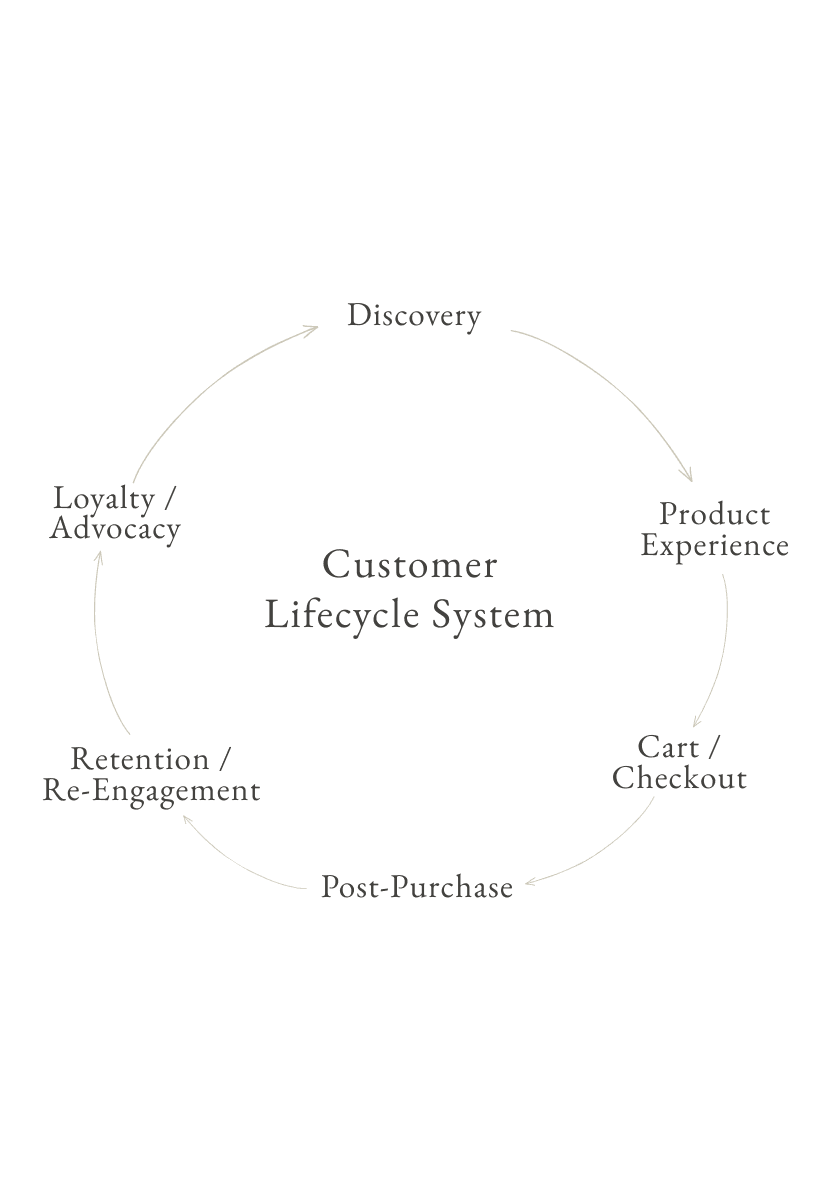
IVY’s positioning was translated into a circular lifecycle system where each touchpoint reinforced consistent expectations: from first exposure to repeat purchase.
Creating consistent and automated positive brand experiences throughout the customer journey with a degree of personalization was essential. The work focused on rebuilding the structure behind the business so growth could continue without requiring constant promotional effort.
This included rebuilding how customers navigated the site, how products and collections were coordinated, how customers became incentivized towards loyalty, the communication they received before and after their purchases, and introducing more self-serve options for customers to reduce support debt.
With less dependence on manual intervention at each touchpoint, space was created to focus on structured seasonal planning and curating styles.
IVY’s founders could now move away from scrambling to manage day-to-day operations and towards dedicated capacity focused on growing the brand – alongside getting time back with their family.

Optimizing the business model
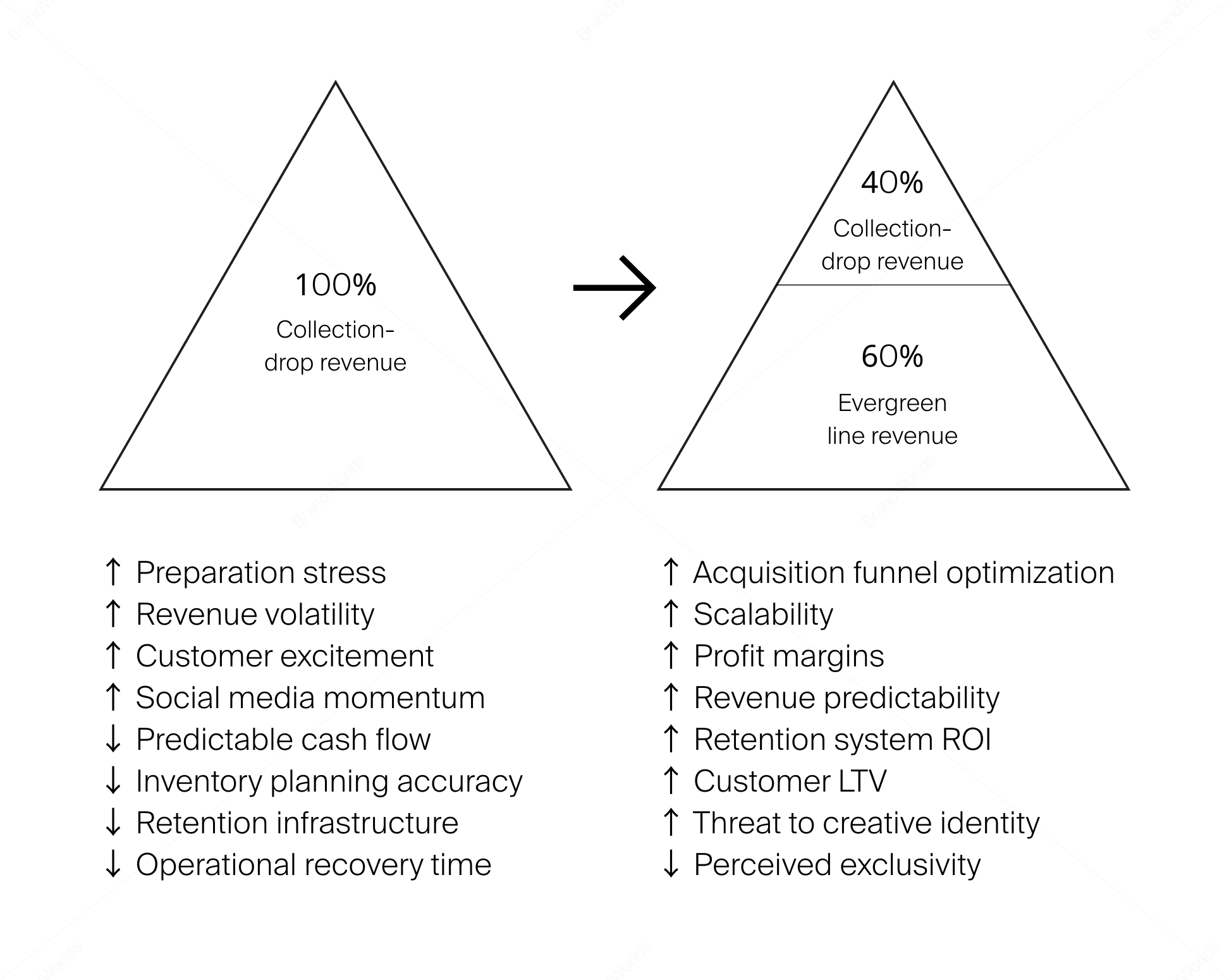
IVY’s founders would be able to continue to focus on curating masterpieces while their evergreen products compounded revenue growth in the background.
The system also modelled a more controlled growth path with roughly half of the brand’s revenue generated through a core product line.
The objective was not acceleration at all costs. It was non-chaotic growth that would decrease operational stress.
With the introduction of a consistently available core product line, the brand could move away from an erratic and unpredictable weekly collection-drop only model and towards a more stable and compounding growth system that allowed for methodical testing and optimizing of paid media, product and collection pages, cart and checkout pages along with pre and post-purchase customer journey touchpoints.
The system was structured to support long-term growth, scalable operations and manageable founder involvement levels.


Traffic Required to Grow Sales
½ – ⅓
Conversion Rate
2.3x
New Customers
1.5x
Total Orders
1.3x
Items Ordered
1.4x
New Customer Orders
1.3x
Revenue per Visitor
2.7x
Returned Items
< 10%
Returning Customer Rate
Stable
First stability, then growth
Once risk was managed and the structure of the business evolved, the performance profile changed and the business entered a new phase showing compounding effects of the key systems installed.
Over the following year, IVY recorded the following on purely organic traffic:
These results occurred without paid acquisition and without re-introducing price-led competition. Growth followed stability as a result of installing fundamental systems scaling brands need to survive expansion.
Early 2026 performance indicates the business is already exceeding the prior year's growth trajectory, suggesting the changes function as durable systems rather than one-time improvements.
"The professionalism, attention to every detail regarding our industry, and dedication to our brand's success is something I have never experienced in our 10 years of existence.
We are not just another client or number. We are partners of success."

Layla Rochefort
Co-founder of IVY
Technical Scope
The below represents a non-comprehensive summary of systems installed.
Positioning & Assortment
- ■Marketing & competitive landscape analysis
- ■Customer interviews & insight synthesis
- ■Historical cohort analysis
- ■Exclusive sourcing strategy
- ■Updated brand narrative & market positioning
Digital & Operations Infrastructure
- ■Multi-phase site build
- ■Custom account architecture
- ■Self-serve return & support
- ■Internal workflow automation
Lifecycle & Retention
- ■Automated lifecycle flows
- ■Personalized product logic
- ■Multi-view product page to wishlist logic
- ■Loyalty architecture & tier logic
Precision Growth
- ■Evergreen model development
- ■Tiered influencer framework
- ■Controlled inventory seeding
- ■Margin model restructuring
Reflections
This engagement was not defined by campaigns or surface optimization.
It was defined by the creation of a clear differentiator and a reason for customers to invest emotionally in the brand, the systems required to continually strengthen them, and the operational relief necessary for the brand to grow without eroding itself in the process.
Stability created the conditions for growth. Growth validated the structure that made it possible.

Contact
Ready to change your Brand World?
"I trust them to deliver exceptionally detailed insights, understand next level buying motivations quickly, and provide actionable insights to help brands grow profitably."

Anya Ustinova
E-commerce Expert
When years of growth hide a relevance gap
Multiple years of high double-digit to three-digit percentage annual sales growth had concealed a strategic vulnerability and placed them in a fragile competitive trap many businesses face as market competition grows: sales for the sake of top-line growth.
Once a full competitive landscape report was produced, clear, but uncomfortable truths surfaced:
With no clear differentiator and selling similar products as their competitors, they were being forced to stay relevant to customers with one operating rule: price every product 10% lower than the lowest-priced competitor.
Competing in price wars also meant training their customers to expect — and wait for — discounts while lowering the brand’s perceived value. Conversion efficiency had significantly deteriorated with a lower percentage of online shoppers becoming customers each year, more traffic was needed to reach the same revenue levels. Despite periods where traffic quadrupled relative to baseline, revenue growth increasingly required disproportionate traffic.
As a result of the changing social media landscape and being an organic-acquisition only business, discounting to stay relevant was no longer a viable option.
Most brands reselling clothing end their years with single to bottom-of-scale double-digit net margins and commodity-level brand perception, but IVY’s customer interviews revealed significant opportunities for the brand to be different:
Their highest-value cohort – customers who had each spent up to multiple five figures with the brand over the past few years – consistently purchased for uniqueness, fit, and the sense of self each piece evoked within them rather than price. The following cohort showed similar patterns, indicating latent demand for exclusivity the existing strategy was not serving.
Multiple years of high double-digit to three-digit percentage annual sales growth had concealed a strategic vulnerability and placed them in a fragile competitive trap many businesses face as market competition grows: sales for the sake of top-line growth.
Once a full competitive landscape report was produced, clear, but uncomfortable truths surfaced:
Competing in price wars also meant training their customers to expect — and wait for — discounts while lowering the brand’s perceived value. Conversion efficiency had significantly deteriorated with a lower percentage of online shoppers becoming customers each year, more traffic was needed to reach the same revenue levels. Despite periods where traffic quadrupled relative to baseline, revenue growth increasingly required disproportionate traffic.
As a result of the changing social media landscape and being an organic-acquisition only business, discounting to stay relevant was no longer a viable option.
Most brands reselling clothing end their years with single to bottom-of-scale double-digit net margins and commodity-level brand perception, but IVY’s customer interviews revealed significant opportunities for the brand to be different:
Their highest-value cohort – customers who had each spent up to multiple five figures with the brand over the past few years – consistently purchased for uniqueness, fit, and the sense of self each piece evoked within them rather than price. The following cohort showed similar patterns, indicating latent demand for exclusivity the existing strategy was not serving.
Multiple years of high double-digit to three-digit percentage annual sales growth had concealed a strategic vulnerability and placed them in a fragile competitive trap many businesses face as market competition grows: sales for the sake of top-line growth.
Once a full competitive landscape report was produced, clear, but uncomfortable truths surfaced:
Competing in price wars also meant training their customers to expect — and wait for — discounts while lowering the brand’s perceived value. Conversion efficiency had significantly deteriorated with a lower percentage of online shoppers becoming customers each year, more traffic was needed to reach the same revenue levels. Despite periods where traffic quadrupled relative to baseline, revenue growth increasingly required disproportionate traffic.
As a result of the changing social media landscape and being an organic-acquisition only business, discounting to stay relevant was no longer a viable option.
Most brands reselling clothing end their years with single to bottom-of-scale double-digit net margins and commodity-level brand perception, but IVY’s customer interviews revealed significant opportunities for the brand to be different:
Their highest-value cohort – customers who had each spent up to multiple five figures with the brand over the past few years – consistently purchased for uniqueness, fit, and the sense of self each piece evoked within them rather than price. The following cohort showed similar patterns, indicating latent demand for exclusivity the existing strategy was not serving.
Multiple years of high double-digit to three-digit percentage annual sales growth had concealed a strategic vulnerability and placed them in a fragile competitive trap many businesses face as market competition grows: sales for the sake of top-line growth.
Once a full competitive landscape report was produced, clear, but uncomfortable truths surfaced:
Competing in price wars also meant training their customers to expect — and wait for — discounts while lowering the brand’s perceived value. Conversion efficiency had significantly deteriorated with a lower percentage of online shoppers becoming customers each year, more traffic was needed to reach the same revenue levels. Despite periods where traffic quadrupled relative to baseline, revenue growth increasingly required disproportionate traffic.
As a result of the changing social media landscape and being an organic-acquisition only business, discounting to stay relevant was no longer a viable option.
Most brands reselling clothing end their years with single to bottom-of-scale double-digit net margins and commodity-level brand perception, but IVY’s customer interviews revealed significant opportunities for the brand to be different:
Their highest-value cohort – customers who had each spent up to multiple five figures with the brand over the past few years – consistently purchased for uniqueness, fit, and the sense of self each piece evoked within them rather than price. The following cohort showed similar patterns, indicating latent demand for exclusivity the existing strategy was not serving.
When years of growth hide a relevance gap
With no clear differentiator and selling similar products as their competitors, they were being forced to stay relevant to customers with one operating rule: price every product 10% lower than the lowest-priced competitor.
When years of growth hide a relevance gap
With no clear differentiator and selling similar products as their competitors, they were being forced to stay relevant to customers with one operating rule: price every product 10% lower than the lowest-priced competitor.
When years of growth hide a relevance gap
With no clear differentiator and selling similar products as their competitors, they were being forced to stay relevant to customers with one operating rule: price every product 10% lower than the lowest-priced competitor.
When years of growth hide a relevance gap
Multiple years of high double-digit to three-digit percentage annual sales growth had concealed a strategic vulnerability and placed them in a fragile competitive trap many businesses face as market competition grows: sales for the sake of top-line growth.
Once a full competitive landscape report was produced, clear, but uncomfortable truths surfaced:
With no clear differentiator and selling similar products as their competitors, they were being forced to stay relevant to customers with one operating rule: price every product 10% lower than the lowest-priced competitor.
Competing in price wars also meant training their customers to expect — and wait for — discounts while lowering the brand’s perceived value. Conversion efficiency had significantly deteriorated with a lower percentage of online shoppers becoming customers each year, more traffic was needed to reach the same revenue levels. Despite periods where traffic quadrupled relative to baseline, revenue growth increasingly required disproportionate traffic.
As a result of the changing social media landscape and being an organic-acquisition only business, discounting to stay relevant was no longer a viable option.
Most brands reselling clothing end their years with single to bottom-of-scale double-digit net margins and commodity-level brand perception, but IVY’s customer interviews revealed significant opportunities for the brand to be different:
Their highest-value cohort – customers who had each spent up to multiple five figures with the brand over the past few years – consistently purchased for uniqueness, fit, and the sense of self each piece evoked within them rather than price. The following cohort showed similar patterns, indicating latent demand for exclusivity the existing strategy was not serving.
When years of growth hide a relevance gap
Multiple years of high double-digit to three-digit percentage annual sales growth had concealed a strategic vulnerability and placed them in a fragile competitive trap many businesses face as market competition grows: sales for the sake of top-line growth.
Once a full competitive landscape report was produced, clear, but uncomfortable truths surfaced:
With no clear differentiator and selling similar products as their competitors, they were being forced to stay relevant to customers with one operating rule: price every product 10% lower than the lowest-priced competitor.
Competing in price wars also meant training their customers to expect — and wait for — discounts while lowering the brand’s perceived value. Conversion efficiency had significantly deteriorated with a lower percentage of online shoppers becoming customers each year, more traffic was needed to reach the same revenue levels. Despite periods where traffic quadrupled relative to baseline, revenue growth increasingly required disproportionate traffic.
As a result of the changing social media landscape and being an organic-acquisition only business, discounting to stay relevant was no longer a viable option.
Most brands reselling clothing end their years with single to bottom-of-scale double-digit net margins and commodity-level brand perception, but IVY’s customer interviews revealed significant opportunities for the brand to be different:
Their highest-value cohort – customers who had each spent up to multiple five figures with the brand over the past few years – consistently purchased for uniqueness, fit, and the sense of self each piece evoked within them rather than price. The following cohort showed similar patterns, indicating latent demand for exclusivity the existing strategy was not serving.
When years of growth hide a relevance gap
Multiple years of high double-digit to three-digit percentage annual sales growth had concealed a strategic vulnerability and placed them in a fragile competitive trap many businesses face as market competition grows: sales for the sake of top-line growth.
Once a full competitive landscape report was produced, clear, but uncomfortable truths surfaced:
With no clear differentiator and selling similar products as their competitors, they were being forced to stay relevant to customers with one operating rule: price every product 10% lower than the lowest-priced competitor.
Competing in price wars also meant training their customers to expect — and wait for — discounts while lowering the brand’s perceived value. Conversion efficiency had significantly deteriorated with a lower percentage of online shoppers becoming customers each year, more traffic was needed to reach the same revenue levels. Despite periods where traffic quadrupled relative to baseline, revenue growth increasingly required disproportionate traffic.
As a result of the changing social media landscape and being an organic-acquisition only business, discounting to stay relevant was no longer a viable option.
Most brands reselling clothing end their years with single to bottom-of-scale double-digit net margins and commodity-level brand perception, but IVY’s customer interviews revealed significant opportunities for the brand to be different:
Their highest-value cohort – customers who had each spent up to multiple five figures with the brand over the past few years – consistently purchased for uniqueness, fit, and the sense of self each piece evoked within them rather than price. The following cohort showed similar patterns, indicating latent demand for exclusivity the existing strategy was not serving.
When years of growth hide a relevance gap
Multiple years of high double-digit to three-digit percentage annual sales growth had concealed a strategic vulnerability and placed them in a fragile competitive trap many businesses face as market competition grows: sales for the sake of top-line growth.
Once a full competitive landscape report was produced, clear, but uncomfortable truths surfaced:
With no clear differentiator and selling similar products as their competitors, they were being forced to stay relevant to customers with one operating rule: price every product 10% lower than the lowest-priced competitor.
Competing in price wars also meant training their customers to expect — and wait for — discounts while lowering the brand’s perceived value. Conversion efficiency had significantly deteriorated with a lower percentage of online shoppers becoming customers each year, more traffic was needed to reach the same revenue levels. Despite periods where traffic quadrupled relative to baseline, revenue growth increasingly required disproportionate traffic.
As a result of the changing social media landscape and being an organic-acquisition only business, discounting to stay relevant was no longer a viable option.
Most brands reselling clothing end their years with single to bottom-of-scale double-digit net margins and commodity-level brand perception, but IVY’s customer interviews revealed significant opportunities for the brand to be different:
Their highest-value cohort – customers who had each spent up to multiple five figures with the brand over the past few years – consistently purchased for uniqueness, fit, and the sense of self each piece evoked within them rather than price. The following cohort showed similar patterns, indicating latent demand for exclusivity the existing strategy was not serving.
From discount wars to a brand customers see themselves in
A mother-and-daughter-run boutique curating premium global styles not yet available in Canada for women who had aged out of trend-driven fast fashion but did not want to lose their sense of individuality.
From discount wars to a brand customers see themselves in
The first intervention was not operational. It was creating a clear definition of who they were, what they stood for, and which brand world their customers belonged to. They needed their customers to see themselves in the brand.
IVY’s story was transformed into something customers could emotionally connect with:
A mother-and-daughter-run boutique curating premium global styles not yet available in Canada for women who had aged out of trend-driven fast fashion but did not want to lose their sense of individuality.
That positioning shift created more exclusivity and anticipation for releases.
That became an operating filter. It governed buying decisions, pricing tolerance, visual language, and marketing restraint.
More customers were pulled toward buying what made them feel comfortable and confident in their clothes while remaining distinctive from their peers and were more willing to invest in premium products they knew would last.
The new positioning allowed IVY to reduce reliance on price competition while strengthening pricing power on select lines, without increasing acquisition pressure.
The first intervention was not operational. It was creating a clear definition of who they were, what they stood for, and which brand world their customers belonged to. They needed their customers to see themselves in the brand.
IVY’s story was transformed into something customers could emotionally connect with:
That business model shift created more exclusivity and anticipation for releases.
That became an operating filter. It governed buying decisions, pricing tolerance, visual language, and marketing restraint.
More customers were pulled toward buying what made them feel comfortable and confident in their clothes while remaining distinctive from their peers and were more willing to invest in premium products they knew would last.
The new positioning allowed IVY to reduce reliance on price competition while strengthening pricing power on select lines, without increasing acquisition pressure.
From discount wars to a brand customers see themselves in
The first intervention was not operational. It was creating a clear definition of who they were, what they stood for, and which brand world their customers belonged to. They needed their customers to see themselves in the brand.
IVY’s story was transformed into something customers could emotionally connect with:
A mother-and-daughter-run boutique curating premium global styles not yet available in Canada for women who had aged out of trend-driven fast fashion but did not want to lose their sense of individuality.
That business model shift created more exclusivity and anticipation for releases.
That became an operating filter. It governed buying decisions, pricing tolerance, visual language, and marketing restraint.
More customers were pulled toward buying what made them feel comfortable and confident in their clothes while remaining distinctive from their peers and were more willing to invest in premium products they knew would last.
The new positioning allowed IVY to reduce reliance on price competition while strengthening pricing power on select lines, without increasing acquisition pressure.
From discount wars to a brand customers see themselves in
The first intervention was not operational. It was creating a clear definition of who they were, what they stood for, and which brand world their customers belonged to. They needed their customers to see themselves in the brand.
IVY’s story was transformed into something customers could emotionally connect with:
A mother-and-daughter-run boutique curating premium global styles not yet available in Canada for women who had aged out of trend-driven fast fashion but did not want to lose their sense of individuality.
That positioning shift created more exclusivity and anticipation for releases.
That became an operating filter. It governed buying decisions, pricing tolerance, visual language, and marketing restraint.
More customers were pulled toward buying what made them feel comfortable and confident in their clothes while remaining distinctive from their peers and were more willing to invest in premium products they knew would last.
The new positioning allowed IVY to reduce reliance on price competition while strengthening pricing power on select lines, without increasing acquisition pressure.
Turning positioning into systems
With a clear value proposition in place, the work moved from story to frameworks.
IVY’s positioning was translated into a circular lifecycle system where each touchpoint reinforced consistent expectations: from first exposure to repeat purchase.
Creating consistent and automated positive brand experiences throughout the customer journey with a degree of personalization was essential. The work focused on rebuilding the structure behind the business so growth could continue without requiring constant promotional effort.
This included rebuilding how customers navigated the site, how products and collections were coordinated, how customers became incentivized towards loyalty, the communication they received before and after their purchases, and introducing more self-serve options for customers to reduce support debt.
With less dependence on manual intervention at each touchpoint, space was created to focus on structured seasonal planning and curating styles.
IVY’s founders could now move away from scrambling to manage day-to-day operations and towards dedicated capacity focused on growing the brand – alongside getting time back with their family.
Immediately following the first phase of changes, the online store began converting nearly 1.5x the amount of traffic the following two months with three quarters to nearly half the amount of traffic compared to the previous year. The following six months – a typically slow period for seasonal businesses like IVY’s – they turned an average of over 2.25x more visitors into customers without paid acquisition.
Turning positioning into systems
With a clear value proposition in place, the work moved from story to frameworks.
IVY’s positioning was translated into a circular lifecycle system where each touchpoint reinforced consistent expectations: from first exposure to repeat purchase.
Creating consistent and automated positive brand experiences throughout the customer journey with a degree of personalization was essential. The work focused on rebuilding the structure behind the business so growth could continue without requiring constant promotional effort.
This included rebuilding how customers navigated the site, how products and collections were coordinated, how customers became incentivized towards loyalty, the communication they received before and after their purchases, and introducing more self-serve options for customers to reduce support debt.
Immediately following the first phase of changes, the online store began converting nearly 1.5x the amount of traffic the following two months with three quarters to nearly half the amount of traffic compared to the previous year. The following six months – a typically slow period for seasonal businesses like IVY’s – they turned an average of over 2.25x more visitors into customers without paid acquisition.
With less dependence on manual intervention at each touchpoint, space was created to focus on structured seasonal planning and curating styles.
IVY’s founders could now move away from scrambling to manage day-to-day operations and towards dedicated capacity focused on growing the brand – alongside getting time back with their family.
Turning positioning into systems
With a clear value proposition in place, the work moved from story to frameworks.
IVY’s positioning was translated into a circular lifecycle system where each touchpoint reinforced consistent expectations: from first exposure to repeat purchase.
Creating consistent and automated positive brand experiences throughout the customer journey with a degree of personalization was essential. The work focused on rebuilding the structure behind the business so growth could continue without requiring constant promotional effort.
This included rebuilding how customers navigated the site, how products and collections were coordinated, how customers became incentivized towards loyalty, the communication they received before and after their purchases, and introducing more self-serve options for customers to reduce support debt.
Immediately following the first phase of changes, the online store began converting nearly 1.5x the amount of traffic the following two months with three quarters to nearly half the amount of traffic compared to the previous year. The following six months – a typically slow period for seasonal businesses like IVY’s – they turned an average of over 2.25x more visitors into customers without paid acquisition.
With less dependence on manual intervention at each touchpoint, space was created to focus on structured seasonal planning and curating styles.
IVY’s founders could now move away from scrambling to manage day-to-day operations and towards dedicated capacity focused on growing the brand – alongside getting time back with their family.
Turning positioning into systems
With less dependence on manual intervention at each touchpoint, space was created to focus on structured seasonal planning and curating styles.
IVY’s founders could now move away from scrambling to manage day-to-day operations and towards dedicated capacity focused on growing the brand – alongside getting time back with their family.
With a clear value proposition in place, the work moved from story to frameworks.
IVY’s positioning was translated into a circular lifecycle system where each touchpoint reinforced consistent expectations: from first exposure to repeat purchase.
Creating consistent and automated positive brand experiences throughout the customer journey with a degree of personalization was essential. The work focused on rebuilding the structure behind the business so growth could continue without requiring constant promotional effort.
This included rebuilding how customers navigated the site, how products and collections were coordinated, how customers became incentivized towards loyalty, the communication they received before and after their purchases, and introducing more self-serve options for customers to reduce support debt.
Immediately following the first phase of changes, the online store began converting nearly 1.5x the amount of traffic the following two months with three quarters to nearly half the amount of traffic compared to the previous year. The following six months – a typically slow period for seasonal businesses like IVY’s – they turned an average of over 2.25x more visitors into customers without paid acquisition.
With a clear value proposition in place, the work moved from story to frameworks.
IVY’s positioning was translated into a circular lifecycle system where each touchpoint reinforced consistent expectations: from first exposure to repeat purchase.
Creating consistent and automated positive brand experiences throughout the customer journey with a degree of personalization was essential. The work focused on rebuilding the structure behind the business so growth could continue without requiring constant promotional effort.
This included rebuilding how customers navigated the site, how products and collections were coordinated, how customers became incentivized towards loyalty, the communication they received before and after their purchases, and introducing more self-serve options for customers to reduce support debt.
Turning positioning into systems
With less dependence on manual intervention at each touchpoint, space was created to focus on structured seasonal planning and curating styles.
IVY’s founders could now move away from scrambling to manage day-to-day operations and towards dedicated capacity focused on growing the brand – alongside getting time back with their family.
Immediately following the first phase of changes, the online store began converting nearly 1.5x the amount of traffic the following two months with three quarters to nearly half the amount of traffic compared to the previous year. The following six months – a typically slow period for seasonal businesses like IVY’s – they turned an average of over 2.25x more visitors into customers without paid acquisition.
Turning positioning into systems
With a clear value proposition in place, the work moved from story to frameworks.
IVY’s positioning was translated into a circular lifecycle system where each touchpoint reinforced consistent expectations: from first exposure to repeat purchase.
Creating consistent and automated positive brand experiences throughout the customer journey with a degree of personalization was essential. The work focused on rebuilding the structure behind the business so growth could continue without requiring constant promotional effort.
This included rebuilding how customers navigated the site, how products and collections were coordinated, how customers became incentivized towards loyalty, the communication they received before and after their purchases, and introducing more self-serve options for customers to reduce support debt.
Immediately following the first phase of changes, the online store began converting nearly 1.5x the amount of traffic the following two months with three quarters to nearly half the amount of traffic compared to the previous year. The following six months – a typically slow period for seasonal businesses like IVY’s – they turned an average of over 2.25x more visitors into customers without paid acquisition.
With less dependence on manual intervention at each touchpoint, space was created to focus on structured seasonal planning and curating styles.
IVY’s founders could now move away from scrambling to manage day-to-day operations and towards dedicated capacity focused on growing the brand – alongside getting time back with their family.
Turning positioning into systems
With a clear value proposition in place, the work moved from story to frameworks.
IVY’s positioning was translated into a circular lifecycle system where each touchpoint reinforced consistent expectations: from first exposure to repeat purchase.
Creating consistent and automated positive brand experiences throughout the customer journey with a degree of personalization was essential. The work focused on rebuilding the structure behind the business so growth could continue without requiring constant promotional effort.
This included rebuilding how customers navigated the site, how products and collections were coordinated, how customers became incentivized towards loyalty, the communication they received before and after their purchases, and introducing more self-serve options for customers to reduce support debt.
With less dependence on manual intervention at each touchpoint, space was created to focus on structured seasonal planning and curating styles.
IVY’s founders could now move away from scrambling to manage day-to-day operations and towards dedicated capacity focused on growing the brand – alongside getting time back with their family.
Turning positioning into systems
With a clear value proposition in place, the work moved from story to frameworks.
IVY’s positioning was translated into a circular lifecycle system where each touchpoint reinforced consistent expectations: from first exposure to repeat purchase.
Creating consistent and automated positive brand experiences throughout the customer journey with a degree of personalization was essential. The work focused on rebuilding the structure behind the business so growth could continue without requiring constant promotional effort.
This included rebuilding how customers navigated the site, how products and collections were coordinated, how customers became incentivized towards loyalty, the communication they received before and after their purchases, and introducing more self-serve options for customers to reduce support debt.
With less dependence on manual intervention at each touchpoint, space was created to focus on structured seasonal planning and curating styles.
IVY’s founders could now move away from scrambling to manage day-to-day operations and towards dedicated capacity focused on growing the brand – alongside getting time back with their family.
Immediately following the first phase of changes, the online store began converting nearly 1.5x the amount of traffic the following two months with three quarters to nearly half the amount of traffic compared to the previous year. The following six months – a typically slow period for seasonal businesses like IVY’s – they turned an average of over 2.25x more visitors into customers without paid acquisition.
Immediately following the first phase of changes, the online store began converting nearly 1.5x the amount of traffic the following two months with three quarters to nearly half the amount of traffic compared to the previous year. The following six months – a typically slow period for seasonal businesses like IVY’s – they turned an average of over 2.25x more visitors into customers without paid acquisition.
Turning positioning into systems
With a clear value proposition in place, the work moved from story to frameworks.
IVY’s positioning was translated into a circular lifecycle system where each touchpoint reinforced consistent expectations: from first exposure to repeat purchase.
Creating consistent and automated positive brand experiences throughout the customer journey with a degree of personalization was essential. The work focused on rebuilding the structure behind the business so growth could continue without requiring constant promotional effort.
This included rebuilding how customers navigated the site, how products and collections were coordinated, how customers became incentivized towards loyalty, the communication they received before and after their purchases, and introducing more self-serve options for customers to reduce support debt.
Immediately following the first phase of changes, the online store began converting nearly 1.5x the amount of traffic the following two months with three quarters to nearly half the amount of traffic compared to the previous year. The following six months – a typically slow period for seasonal businesses like IVY’s – they turned an average of over 2.25x more visitors into customers without paid acquisition.
With less dependence on manual intervention at each touchpoint, space was created to focus on structured seasonal planning and curating styles.
IVY’s founders could now move away from scrambling to manage day-to-day operations and towards dedicated capacity focused on growing the brand – alongside getting time back with their family.
Turning positioning into systems
With a clear value proposition in place, the work moved from story to frameworks.
IVY’s positioning was translated into a circular lifecycle system where each touchpoint reinforced consistent expectations: from first exposure to repeat purchase.
Creating consistent and automated positive brand experiences throughout the customer journey with a degree of personalization was essential. The work focused on rebuilding the structure behind the business so growth could continue without requiring constant promotional effort.
This included rebuilding how customers navigated the site, how products and collections were coordinated, how customers became incentivized towards loyalty, the communication they received before and after their purchases, and introducing more self-serve options for customers to reduce support debt.
With less dependence on manual intervention at each touchpoint, space was created to focus on structured seasonal planning and curating styles.
IVY’s founders could now move away from scrambling to manage day-to-day operations and towards dedicated capacity focused on growing the brand – alongside getting time back with their family.
Turning positioning into systems
With a clear value proposition in place, the work moved from story to frameworks.
IVY’s positioning was translated into a circular lifecycle system where each touchpoint reinforced consistent expectations: from first exposure to repeat purchase.
Creating consistent and automated positive brand experiences throughout the customer journey with a degree of personalization was essential. The work focused on rebuilding the structure behind the business so growth could continue without requiring constant promotional effort.
This included rebuilding how customers navigated the site, how products and collections were coordinated, how customers became incentivized towards loyalty, the communication they received before and after their purchases, and introducing more self-serve options for customers to reduce support debt.
Immediately following the first phase of changes, the online store began converting nearly 1.5x the amount of traffic the following two months with three quarters to nearly half the amount of traffic compared to the previous year. The following six months – a typically slow period for seasonal businesses like IVY’s – they turned an average of over 2.25x more visitors into customers without paid acquisition.
Immediately following the first phase of changes, the online store began converting nearly 1.5x the amount of traffic the following two months with three quarters to nearly half the amount of traffic compared to the previous year. The following six months – a typically slow period for seasonal businesses like IVY’s – they turned an average of over 2.25x more visitors into customers without paid acquisition.
With less dependence on manual intervention at each touchpoint, space was created to focus on structured seasonal planning and curating styles.
IVY’s founders could now move away from scrambling to manage day-to-day operations and towards dedicated capacity focused on growing the brand – alongside getting time back with their family.
Optimizing the business model
The system also modelled a more controlled growth path with roughly half of the brand’s revenue generated through a core product line.
The objective was not acceleration at all costs. It was non-chaotic growth that would decrease operational stress.
With the introduction of a consistently available core product line, the brand could move away from an erratic and unpredictable weekly collection-drop only model and towards a more stable and compounding growth system that allowed for methodical testing and optimizing of paid media, product and collection pages, cart and checkout pages along with pre and post-purchase customer journey touchpoints.
IVY’s founders would be able to continue to focus on curating masterpieces while their evergreen products compounded revenue growth in the background.
The system was structured to support long-term growth, scalable operations and manageable founder involvement levels.
Optimizing the business model
The system also modelled a more controlled growth path with roughly half of the brand’s revenue generated through a core product line.
The objective was not acceleration at all costs. It was non-chaotic growth that would decrease operational stress.
With the introduction of a consistently available core product line, the brand could move away from an erratic and unpredictable weekly collection-drop only model and towards a more stable and compounding growth system that allowed for methodical testing and optimizing of paid media, product and collection pages, cart and checkout pages along with pre and post-purchase customer journey touchpoints.
IVY’s founders would be able to continue to focus on curating masterpieces while their evergreen products compounded revenue growth in the background.
The system was structured to support long-term growth, scalable operations and manageable founder involvement levels.
Optimizing the business model
The system also modelled a more controlled growth path with roughly half of the brand’s revenue generated through a core product line.
The objective was not acceleration at all costs. It was non-chaotic growth that would decrease operational stress.
With the introduction of a consistently available core product line, the brand could move away from an erratic and unpredictable weekly collection-drop only model and towards a more stable and compounding growth system that allowed for methodical testing and optimizing of paid media, product and collection pages, cart and checkout pages along with pre and post-purchase customer journey touchpoints.
IVY’s founders would be able to continue focusing on curating their masterpieces while their mostly automated evergreen system compounded revenue growth in the background.
The system was structured to support long-term growth, scalable operations and manageable founder involvement levels.
First stability, then growth
Once risk was managed and the structure of the business evolved, the performance profile changed and the business entered a new phase showing compounding effects of the key systems installed.
Over the following year, IVY recorded the following on purely organic traffic:
Traffic Required to Grow Sales
½ – ⅓
Conversion Rate
2.3x
New Customers
1.5x
Total Orders
1.3x
Items per Order
1.4x
New Customer Orders
1.3x
Revenue per Visitor
2.7x
Returned Items
< 10%
Returning Customer Rate
Stable
Traffic Required to Grow Sales
½ – ⅓
Conversion Rate
2.3x
New Customers
1.5x
Total Orders
1.3x
Items per Order
1.4x
New Customer Orders
1.3x
Revenue per Visitor
2.7x
Returned Items
< 10%
Returning Customer Rate
Stable
These results occurred without paid acquisition and without re-introducing price-led competition. Growth followed stability as a result of installing fundamental systems scaling brands need to survive expansion.
Early 2026 performance indicates the business is already exceeding the prior year's growth trajectory, suggesting the changes function as durable systems rather than one-time improvements.
"The professionalism, attention to every detail regarding our industry, and dedication to our brand's success is something I have never experienced in our 10 years of existence.
We are not just another client or number. We are partners of success."
Layla Rochefort
Co-founder of IVY
Technical Scope
The below represents a non-comprehensive summary of systems installed.
Positioning & Assortment
- ■Marketing & competitive landscape analysis
- ■Customer interviews & insight synthesis
- ■Historical cohort analysis
- ■Exclusive sourcing strategy
- ■Updated brand narrative & market positioning
Digital & Operations Infrastructure
- ■Multi-phase site build
- ■Custom account architecture
- ■Self-serve return & support
- ■Internal workflow automation
Lifecycle & Retention
- ■Automated lifecycle flows
- ■Personalized product logic
- ■Multi-view product page to wishlist logic
- ■Loyalty architecture & tier logic
Precision Growth
- ■Evergreen model development
- ■Tiered influencer framework
- ■Controlled inventory seeding
- ■Margin model restructuring
Reflections
This engagement was not defined by campaigns or surface optimization.
It was defined by the creation of a clear differentiator, a reason for customers to invest emotionally in the brand, the systems required to continually strengthen those choices, and the operational relief necessary for the brand to grow without losing its identity in the process.
Stability created the conditions for growth. Growth validated the structure that made it possible.
"The professionalism, attention to every detail regarding our industry, and dedication to our brand's success is something I have never experienced in our 10 years of existence.
We are not just another client or number. We are partners of success."
Layla Rochefort
Co-founder of IVY
"The professionalism, attention to every detail regarding our industry, and dedication to our brand's success is something I have never experienced in our 10 years of existence.
We are not just another client or number. We are partners of success."
Layla Rochefort
Co-founder of IVY
Technical Scope
The below represents a non-comprehensive summary of systems installed.
Positioning & Assortment
- ■Marketing & competitive landscape analysis
- ■Customer interviews & insight synthesis
- ■Historical cohort analysis
- ■Exclusive sourcing strategy
- ■Updated brand narrative & market positioning
Digital & Operations Infrastructure
- ■Multi-phase site build
- ■Custom account architecture
- ■Self-serve return & support
- ■Internal workflow automation
Lifecycle & Retention
- ■Automated lifecycle flows
- ■Personalized product logic
- ■Multi-view product page to wishlist logic
- ■Loyalty architecture & tier logic
Precision Growth
- ■Evergreen model development
- ■Tiered influencer framework
- ■Controlled inventory seeding
- ■Margin model restructuring
Reflections
This engagement was not defined by campaigns or surface optimization.
It was defined by the creation of a clear differentiator and a reason for customers to invest emotionally in the brand, the systems required to continually strengthen them, and the operational relief necessary for the brand to grow without eroding itself in the process.
Stability created the conditions for growth. Growth validated the structure that made it possible.
Technical Scope
The below represents a non-comprehensive summary of systems installed.
Positioning & Assortment
- ■Marketing & competitive landscape analysis
- ■Customer interviews & insight synthesis
- ■Historical cohort analysis
- ■Exclusive sourcing strategy
- ■Updated brand narrative & market positioning
Digital & Operations Infrastructure
- ■Multi-phase site build
- ■Custom account architecture
- ■Self-serve return & support
- ■Internal workflow automation
Lifecycle & Retention
- ■Automated lifecycle flows
- ■Personalized product logic
- ■Multi-view product page to wishlist logic
- ■Loyalty architecture & tier logic
Precision Growth
- ■Evergreen model development
- ■Tiered influencer framework
- ■Controlled inventory seeding
- ■Margin model restructuring
Reflections
This engagement was not defined by campaigns or surface optimization.
It was defined by the creation of a clear differentiator and a reason for customers to invest emotionally in the brand, the systems required to continually strengthen them, and the operational relief necessary for the brand to grow without eroding itself in the process.
Stability created the conditions for growth. Growth validated the structure that made it possible.
First stability, then growth
Once risk was managed and the structure of the business evolved, the performance profile changed and the business entered a new phase showing compounding effects of the key systems installed.
Over the following year, IVY recorded the following on purely organic traffic:
Traffic Required to Grow
½ – ⅓
Conversion Rate
2.3x
New Customers
1.5x
Total Orders
1.3x
Items per Order
1.4x
New Customer Orders
1.3x
Revenue per Visitor
2.7x
Returned Items
< 10%
Returning Customer Rate
Stable
These results occurred without paid acquisition and without re-introducing price-led competition. Growth followed stability as a result of installing fundamental systems scaling brands need to survive expansion.
Early 2026 performance indicates the business is already exceeding the prior year's growth trajectory, suggesting the changes function as durable systems rather than one-time improvements.
"The professionalism, attention to every detail regarding our industry, and dedication to our brand's success is something I have never experienced in our 10 years of existence.
We are not just another client or number. We are partners of success."
Layla Rochefort
Co-founder of IVY
Technical Scope
The below represents a non-comprehensive summary of systems installed.
Positioning & Assortment
- ■Marketing & competitive landscape analysis
- ■Customer interviews & insight synthesis
- ■Historical cohort analysis
- ■Exclusive sourcing strategy
- ■Updated brand narrative & market positioning
Digital & Operations Infrastructure
- ■Multi-phase site build
- ■Custom account architecture
- ■Self-serve return & support
- ■Internal workflow automation
Lifecycle & Retention
- ■Automated lifecycle flows
- ■Personalized product logic
- ■Multi-view product page to wishlist logic
- ■Loyalty architecture & tier logic
Precision Growth
- ■Evergreen model development
- ■Tiered influencer framework
- ■Controlled inventory seeding
- ■Margin model restructuring
Reflections
This engagement was not defined by campaigns or surface optimization.
It was defined by the creation of a clear differentiator and a reason for customers to invest emotionally in the brand, the systems required to continually strengthen them, and the operational relief necessary for the brand to grow without eroding itself in the process.
Stability created the conditions for growth. Growth validated the structure that made it possible.
"I trust them to deliver exceptionally detailed insights, understand next level buying motivations quickly, and provide actionable insights to help brands grow profitably."
Anya Ustinova
E-commerce Expert
Ready to
change your
Brand World?
Contact
Ready to change your Brand World?
"I trust them to deliver exceptionally detailed insights, understand next level buying motivations quickly, and provide actionable insights to help brands grow profitably."
Anya Ustinova
E-commerce Expert
"I trust them to deliver exceptionally detailed insights, understand next level buying motivations quickly, and provide actionable insights to help brands grow profitably."
Anya Ustinova
E-commerce Expert
Ready to change your
Brand World?
Ready to change your
Brand World?
"I trust them to deliver exceptionally detailed insights, understand next level buying motivations quickly, and provide actionable insights to help brands grow profitably."
Anya Ustinova
E-commerce Expert